Our News
Worse than nicotine—is Switzerland prepared for these Chinese vapes?
Mar
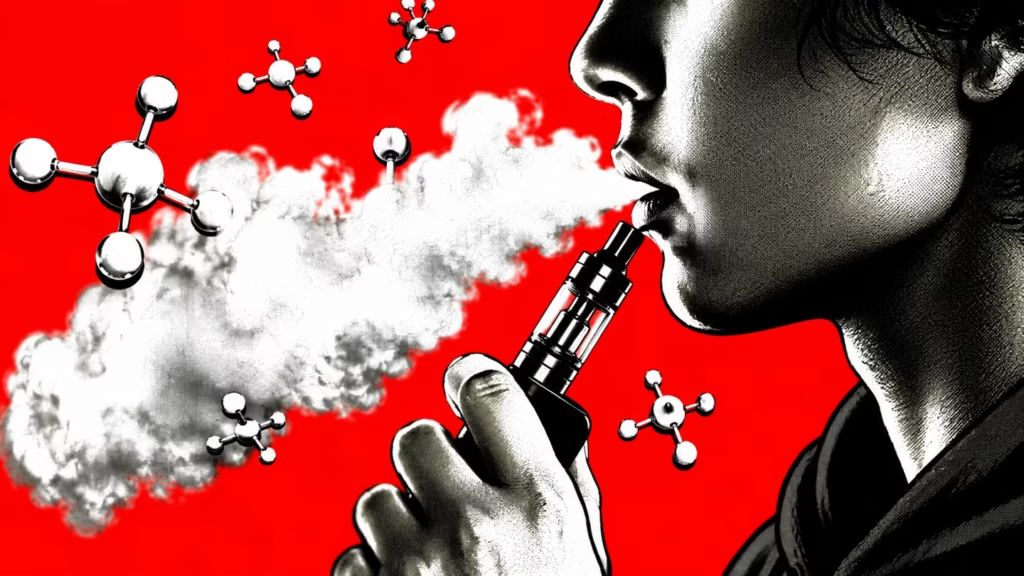
Sales of e-cigarettes have increased worldwide in recent years.
A new class of substances called 6-methylnicotine is circumventing tobacco laws around the world. The first products have already appeared in Switzerland.
In Chinese factories around Shenzhen, the global hub of vape production, a new generation of e-cigarettes is currently being developed. They no longer contain nicotine—at least not in the legal sense. Instead, manufacturers are turning to so-called nicotine analogs: synthetically produced molecules that are chemically similar to nicotine but are structured just slightly differently enough to avoid falling under tobacco laws. The most popular of these is called 6-methylnicotine, or 6-MN for short, and is sold under brand names such as “Metatine,” “Nixotine,” or “NoNic.”
What sounds like a clever trick could actually pose a serious health risk. After all, no one currently knows for certain exactly what 6-MN does to the human body.
Stronger than nicotine, but scarcely studied
Initial laboratory studies paint a troubling picture. A toxicological study of human bronchial cells conducted in 2025 found that the vapor from e-cigarettes containing 6-MN produces more reactive oxygen species than conventional nicotine vapor and causes greater damage to the cells. Animal studies also showed that 6-MN has a higher binding affinity for nicotine receptors in the brain than conventional nicotine. Experts therefore believe it is possible that the substance is more addictive.
Stanford professor Robert Jackler, who has been researching the tobacco industry’s strategies for years, describes the situation to the U.S. magazine *Wired* as a chemical game of cat and mouse. The companies are doing everything they can to circumvent regulations. What’s particularly problematic is that what’s listed on the packaging has little to do with the actual contents. An analysis published in 2024 in the journal *JAMA* also found undeclared ingredients in several 6-MN vapes, including artificial sweeteners and cooling agents with unknown risks when inhaled.
A loophole as big as a factory gate
The story behind nicotine analogs is not the brainchild of Chinese startups. As early as the 1970s, Western tobacco companies were researching nicotine-like compounds. Millions of internal documents, analyzed in a comprehensive review in 2005, show that Philip Morris and others were specifically looking for substitutes that could circumvent potential regulations. However, the major companies never brought these substances to market.
Decades later, Chinese vape manufacturers took over. About 70 percent of the e-cigarettes sold worldwide come from the greater Shenzhen area. When the U.S. Congress tightened tobacco laws in 2022 and brought synthetic nicotine under FDA regulation, manufacturers simply switched to 6-MN. To this day, the U.S. agency defines “nicotine” so narrowly that a single additional methyl molecule on the pyridine ring is sufficient to prevent the substance from being formally classified as nicotine.
It is only a budget proposal from the Trump administration for fiscal year 2027 that calls for expanding the definition of nicotine to include analogs. Stanford researcher Jackler, however, is skeptical about this move as well. The U.S. tobacco giants could then develop nicotine analog products themselves and, at the same time, rid themselves of the unwelcome Chinese competition.
In Switzerland, the laws are lagging behind
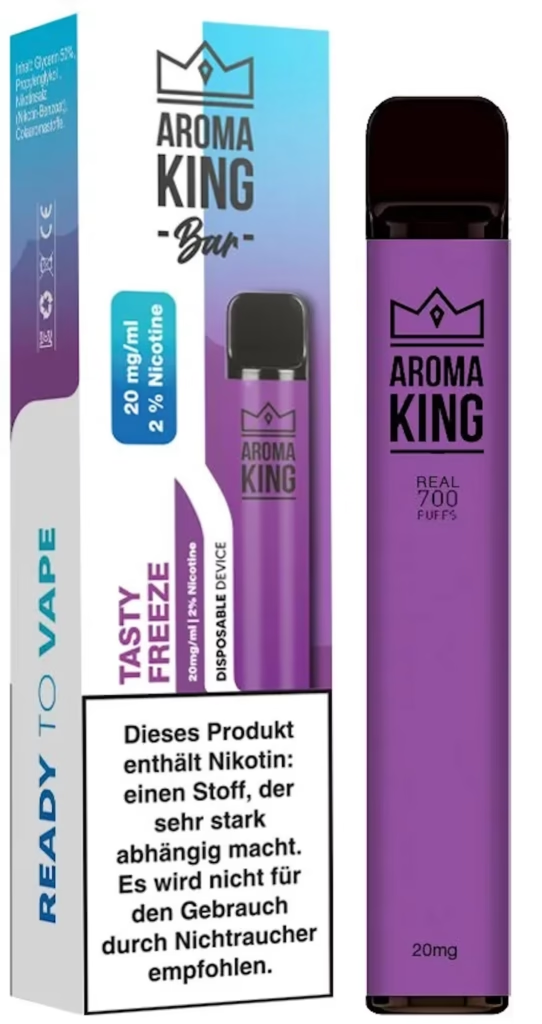
What is a problem in the U.S. also directly affects Europe. Since early 2024, products containing 6-MN have been available on the European market, primarily under the “Aroma King” brand, which markets its vapes and nicotine pouches with the “NoNic” label. Belgian laboratories have detected up to 20 milligrams of 6-MN per pouch. The packaging claims that the products are nicotine-free.
Switzerland is also affected. The Swiss Tobacco Prevention Association (AT Switzerland) sounded the alarm as early as March 2025, reporting that products containing 6-MN can be easily ordered into Switzerland via European online shops. The Aroma King brand has its own online store in Switzerland. Although AT Switzerland has not yet found any 6-MN products on the Swiss Aroma King website, it cannot rule out the possibility that such products are already in circulation, as it lacks the capacity to conduct systematic market surveillance.
Legally, Switzerland is in a gray area. The Tobacco Products Act, which took effect in October 2024 does not define nicotine in detail and does not clearly classify nicotine analogs such as 6-MN as regulated substances. Although e-cigarettes generally fall under the law, the quantity restrictions of a maximum of 20 milligrams per milliliter and 2 milliliters of e-liquid per disposable device apply only to nicotine-containing products. Since 6-MN products are classified as nicotine-free by the Federal Office of Public Health classified as nicotine-free, these limits do not apply. A vape containing 6-MN instead of nicotine therefore technically falls through the cracks.
Aroma-King products are also available in Switzerland.
Aroma King
Political pressure is mounting
National Council member Christophe Clivaz (Greens/VS) submitted an interpellation in the spring of 2025, calling on the Federal Council to provide clarity. Does 6-MN fall under the Tobacco Products Act? If not, can the Federal Council retroactively subject the substance to the Act? And shouldn’t 6-MN be banned as a precautionary measure? AT Switzerland is calling for exactly that and warns against a repeat of the debacle surrounding illegal disposable vapes, which—despite a clear legal framework—were sold for months on platforms like Galaxus without any intervention by the authorities.
Luciano Ruggia, managing director of AT Switzerland, sums up the situation: The industry is constantly developing new ways to circumvent regulations. Switzerland must not fail again when it comes to protecting young people. After all, there is one fundamental difference between the new nicotine analogs and the previous debate over disposable vapes—it is no longer just a matter of tanks that are too large or a lack of age verification, but rather a virtually unexplored substance whose effects on young people are completely unclear.
